What it is
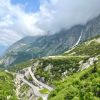
Bwlch y Groes — the Pass of the Cross, known to generations of drivers as Hellfire Pass — is the road that proves you don’t need the Alps to find a proper mountain drive. Climbing to 545 metres between Dinas Mawddwy and Llanuwchllyn near Bala, it’s the highest public mountain road in northern Wales and within a few metres of the highest in the country. A single-track ribbon of tarmac hauls itself out of the Dyfi valley at gradients touching 25%, crests a wild, treeless moorland plateau, then drops toward Bala with a spur peeling off to Lake Vyrnwy.
It’s a road with pedigree. In the early days of the British motor industry, manufacturers brought prototypes here to torture-test engines and brakes — if a car could climb Hellfire Pass without boiling over, it could handle anything the public would throw at it. That heritage is written into the road: it’s short, steep, and utterly uninterested in flattering you or your car.
Is it hard to drive?
Here’s the honest answer: it’s steep, it’s narrow, and the first time you see the gradient sign you’ll take a breath. And then you’ll drive it, and realise it’s entirely manageable.
The climb from the Dinas Mawddwy side is the famous one — around two miles of sustained gradient with a low stone-flanked edge and long views down the valley. It’s single-track with passing places, so the skill is less about heroic driving and more about reading the road ahead, using the passing places early, and keeping momentum on the steep sections. Modern cars — even small ones — handle it without drama. In fact, small and light is the ideal recipe here: this is a road where a well-driven MX-5 or a modest hatchback is having far more fun than anything with 500 horsepower.
If you’d rather have someone else worry about the logistics — the route that strings it together with the best of Snowdonia, where to stay, where the fuel stops are — that’s exactly what our hosted Wales weekend exists for. You drive; we handle everything else.
When to drive it
Bwlch y Groes is open year-round, but it’s a very different road in January than in June. Snow and ice make it genuinely hazardous in winter, and the moorland top is exposed to weather that changes in minutes.
Best window: May to September, when the surface is dry, the days are long and the moorland is at its greenest. Right now — late summer — is prime time: long evenings, settled weather, and quieter roads once the school-holiday coastal traffic has peeled off toward the beaches. Early morning is best of all; you’ll likely have the summit entirely to yourself.
How to drive it
Drive it south to north — from Dinas Mawddwy toward Llanuwchllyn. That puts the steepest, most dramatic climbing ahead of you rather than under your brakes, and serves the big valley view over your shoulder as you rise.
Key moments to savour: the initial hairpinned pull out of the Dyfi valley, where the gradient does its worst; the cattle grid at the crest, where the landscape suddenly opens into empty moorland; and the junction on the plateau where a right turn drops you down a gloriously lonely road to Lake Vyrnwy — take it, it’s one of the best detours in Wales. Park sensibly at the summit and walk a few metres off the road for the classic photograph looking back down the pass.
Watch for sheep (everywhere, always), cyclists testing themselves on the climb, and the occasional walker. This is a shared road in a working landscape — the enthusiast’s move is to drive it briskly but courteously.
Making a day of it
Bwlch y Groes is short — you could drive it in fifteen minutes — which is exactly why it belongs in a bigger loop. Our favourite: start in Dolgellau with breakfast, take the A470 north through the Coed y Brenin forest, cut across to Bala along the lake, then drop south over the pass to Dinas Mawddwy and lunch at a valley pub. In the afternoon, take the Vyrnwy spur road to the lake and its Victorian dam — the road along the western shore is a joy in itself — before looping home over the moors. That’s a hundred-odd miles containing more driving pleasure than most people find in a year.
Fuel and phone signal both deserve a mention: fill up in Bala or Dolgellau, because there’s nothing on the pass itself, and don’t rely on mobile coverage in the valleys. Download your maps before you leave — this corner of Wales is blissfully, occasionally inconveniently, remote. That remoteness is also its gift: on a weekday morning you can have one of Britain’s great roads utterly to yourself, twenty minutes from a decent flat white.
One more reason to go soon: roads like this survive on goodwill. The pass has stayed open, unrestricted and free precisely because the people who drive it treat it well. Go quietly early, park considerately, spend money in the villages — and it’ll still be there, unspoilt, for the next generation of drivers who’ve just discovered what a 25% gradient feels like from the driver’s seat.
Do it with us
Bwlch y Groes is one of the two headline passes on our hosted weekend through the Brecon Beacons and Snowdonia — two nights, two mountain passes, expert-led and fully accommodated.
Related roads
If Bwlch y Groes is on your list, so should be the Llanberis Pass through the heart of Eryri, the Black Mountain Pass (A4069) made famous by a certain TV programme, and the wider question of why Wales is Britain’s ultimate driving playground — we’ve written about all three.