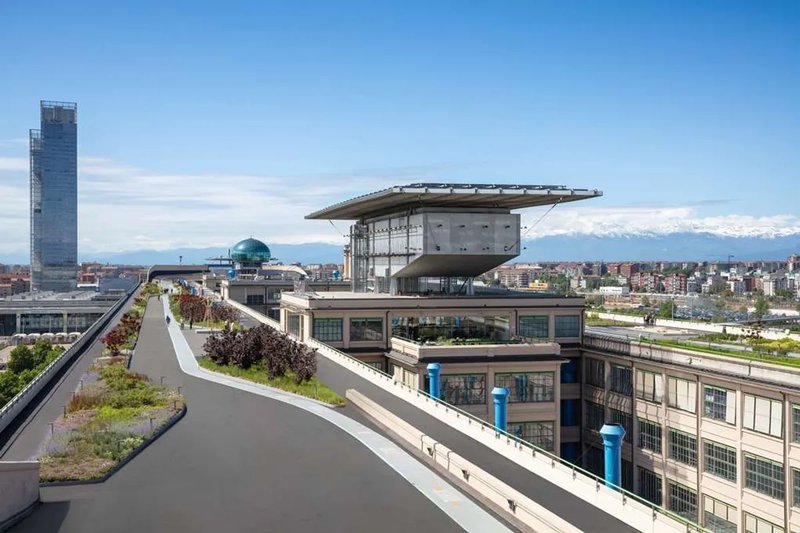
Ian sleeps inside automotive history — the former Fiat factory where cars were built floor by floor and tested on the famous rooftop banked track. The story of the building and what to see during the stay.
A Building Ahead of Its Time
Lingotto wasn’t just a car factory—it was Fiat’s vision of industrial utopia, designed by architect Giacomo Matté Trucco and completed in 1923. The building was revolutionary: five stories tall, each dedicated to one stage of car assembly, with parts flowing downward from raw materials at the top to finished cars emerging from the bottom.
At a time when assembly lines were still novel, Lingotto represented the cutting edge of manufacturing philosophy. The idea was elegant: gravity would do much of the work, and cars would literally descend through the building as they were assembled.
What made it truly audacious, though, was the rooftop. Rather than waste the 4.7-acre expanse of the roof, Fiat added a 393-meter banked oval race track where the assembled cars could be tested and drivers could be trained. A rooftop race track remains extraordinary today; in the 1920s it was inconceivable.
The Italian Job Connection
Lingotto achieved cultural immortality in 1969 when Michael Caine, Noël Coward, and a fleet of Mini Coopers made the famous car-on-the-rooftop scene for The Italian Job. That climactic sequence—three Minis performing a brilliant rooftop escape—couldn’t have been filmed anywhere else. The building’s distinctive checkered paint pattern and dramatic height made it instantly recognizable.
Fiat closed the Lingotto factory in 1982, but that film scene ensured the building would never be forgotten. Car enthusiasts worldwide have since made pilgrimage to see the real rooftop.
Architecture and Design Innovation
Every detail of Lingotto’s design served a purpose. The building’s skeleton is reinforced concrete—pioneering for its time. The five-story vertical assembly line saved space, time, and money. The sloped ramps connecting each level were precisely engineered. And the rooftop track wasn’t decoration; it was a working test facility.
The building’s external appearance is equally striking: a massive rectangular slab of industrial rationalism with minimal ornamentation. It’s purely functional design, yet it has a monumental beauty that more decorated structures struggle to achieve.
What to See During Your Stay
Lingotto was converted to the NH Hotels Turin Lingotto in 2000, and guests can explore far more than typical hotel visitors. The rooftop track is open during the day, offering a chance to walk the actual surface where Fiat tested cars and where Michael Caine drove. The views of Turin from up there are extraordinary.
The building’s conversion preserved much of its industrial character. You can see the original assembly line infrastructure, the scale of the production spaces, and appreciate the engineering genius that went into its design. Some areas retain their original Fiat fixtures and signage.
If time allows, the Pinacoteca Agnelli art gallery operates within part of the building, offering an unexpected contrast between industrial heritage and fine art.
Modern Renovation and the NH Hotels Experience
The 2000 renovation was respectful of the original design. The hotel maintains the building’s integrity while adding modern comfort. Guest rooms occupy what were once office and administrative spaces, so they’re spacious and interesting—no cookie-cutter hotel uniformity here.
The rooftop bar is perfect for sunset, looking out over Turin. The parking, cleverly, is on the lowest levels, maintaining the building’s relationship with the street. This is not a hotel that compromises its architectural host to achieve higher profits—it honors it.
A bespoke tour by Road Trip Club