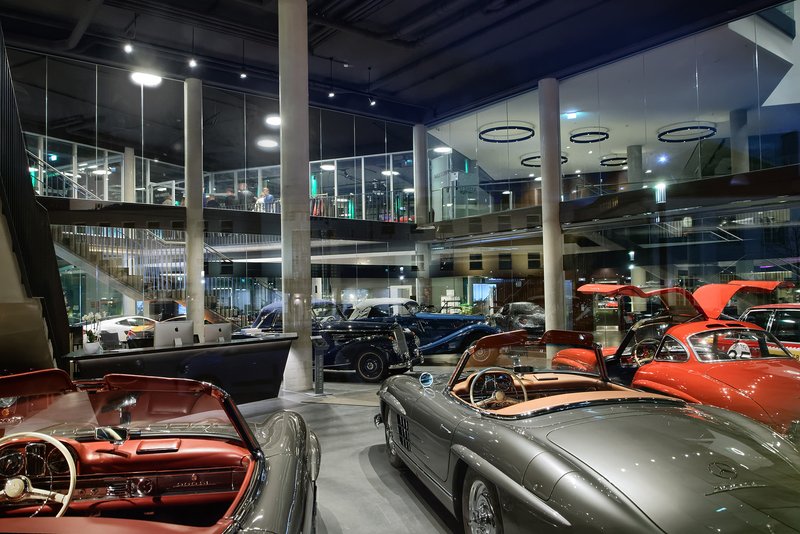
The Mercedes-Benz and Porsche museums, why both are worth the time, and the V8 Hotel’s car-themed rooms at Motorworld — finished with a nod to the b’mine Düsseldorf CarLift the following night as the trip’s final flourish.
Stuttgart’s Automotive Heritage
Stuttgart is Germany’s automotive heartland. Gottlieb Daimler and Karl Benz—separately the inventors of the internal combustion engine and the automobile—both worked in Stuttgart. The city has been the center of automotive innovation and manufacturing for over 150 years. Mercedes, Porsche, and dozens of components suppliers are based here. To visit Stuttgart is to visit the birthplace of the car itself.
This heritage isn’t mere history—it shapes the city’s present. Stuttgart residents speak about cars with the kind of passion that residents of other cities reserve for art, philosophy, or literature. Cars aren’t a business here; they’re a cultural expression.
Mercedes-Benz Museum: Scope and Highlights
The Mercedes-Benz Museum is one of the world’s greatest automotive museums, not because it has the most cars, but because it tells the complete story of automotive and industrial history through Mercedes’ development. The museum occupies nine levels and covers 160 years of innovation.
The narrative begins with the invention of the internal combustion engine and follows the automobile’s evolution through every major era: the early steam cars, the first gasoline engines, the racing era, the post-war recovery, the jet-age 1950s cars, the revolutionary 300 SL “Gullwing,” and the modern hypercars.
Highlights include: the 1886 Benz Motorwagen (arguably the first true automobile), Mercedes’ racing heritage including Formula 1 cars and legendary 300 SLR, the stunning 300 SL Gullwing in multiple variants, and the modern hypercar collection. Every car on display is immaculately restored and positioned to tell its story clearly.
The museum deliberately avoids overwhelming clutter. Each car has space to be appreciated, and the thematic flow is logical and compelling. Plan for 3-4 hours minimum—longer if you’re deeply interested in automotive history. Guided tours are available and worthwhile.
Porsche Museum: Architecture and Collection
The Porsche Museum is a different experience: smaller than Mercedes but architecturally spectacular. The building itself is a work of art—a modern structure designed by Delugan Meissl that cantilevers over Stuttgart’s landscape in a way that feels almost organic.
The collection focuses on Porsche’s racing heritage and engineering philosophy. Starting with the 356 (the first Porsche, built in 1948) and proceeding through every major model line and racing variant. You see how Porsche’s obsession with weight reduction and handling precision has defined every car the company has ever built.
Key cars include: the 356 in multiple generations, the legendary 917 racing cars that dominated Le Mans in the 1970s, the 911 in all its variants, the 918 Spyder hybrid hypercar, and current models. The engineering is displayed as openly as the design—you see suspension components, engine cutaways, and technical specifications everywhere.
The museum is smaller than Mercedes (about 2 hours to see everything) but feels more intimate. The emphasis is on how Porsche thinks about cars rather than merely what cars Porsche has built.
The V8 Hotel and Motorworld
The V8 Hotel at Motorworld Stuttgart is an experience unlike any other hotel in the world. It’s themed entirely around cars—but not in a kitsch way. The concept is sophisticated and somewhat obsessive.
Guest rooms are themed around individual cars or automotive concepts. You might stay in the “Porsche 911 room” with a car interior as part of the décor, or the “Formula 1” room with racing memorabilia, or the “Carrera Panamericana” room themed after the legendary Mexican road race. Some rooms have actual car parts integrated into the design (dashboards, steering wheels, wheels).
Motorworld Stuttgart itself is a massive gathering of automotive enthusiasts—a kind of permanent automotive exposition where restored and modified cars are displayed, bought and sold, and admired by people for whom cars are a genuine passion. Walking through Motorworld feels like wandering through a car enthusiast’s dream.
The V8 Hotel has an excellent restaurant serving Swabian food (traditional to the Stuttgart region) and an extraordinary bar where every surface relates to cars. It’s not parody—it’s a genuine expression of car culture at a level of detail and commitment most of the world won’t understand, but car enthusiasts find perfect.
A Preview of Düsseldorf’s b’mine CarLift
The trip concludes with one more automotive flourish in Düsseldorf: the b’mine CarLift, a unique Porsche dealership that displays its inventory not in a traditional showroom but in a vertical storage tower. Cars are automatically lowered from the tower on demand—a technical marvel and a perfect final stop for a trip that began with great driving and is ending in automotive celebration.
Stuttgart is the climax; Düsseldorf is the parenthetical exclamation point. Both experience the car culture of Germany at its most intense and committed.
Practical Information
Both museums are open daily (hours vary seasonally, so check ahead). Admission to Mercedes is approximately €9, Porsche approximately €10. Both have excellent cafés. Public transportation in Stuttgart is excellent—the museum are easily accessed via U-Bahn.
Motorworld Stuttgart is open daily and free to explore. The V8 Hotel can be booked directly. A single night there is a singular experience—the hotel is not luxury in the traditional sense, but it is absolutely unique.
Allow a full day in Stuttgart: morning at Mercedes or Porsche, afternoon at the other museum, evening at Motorworld and dinner at the V8 Hotel. This is a day to celebrate arriving at the very heart of automotive history and culture.
A bespoke tour by Road Trip Club